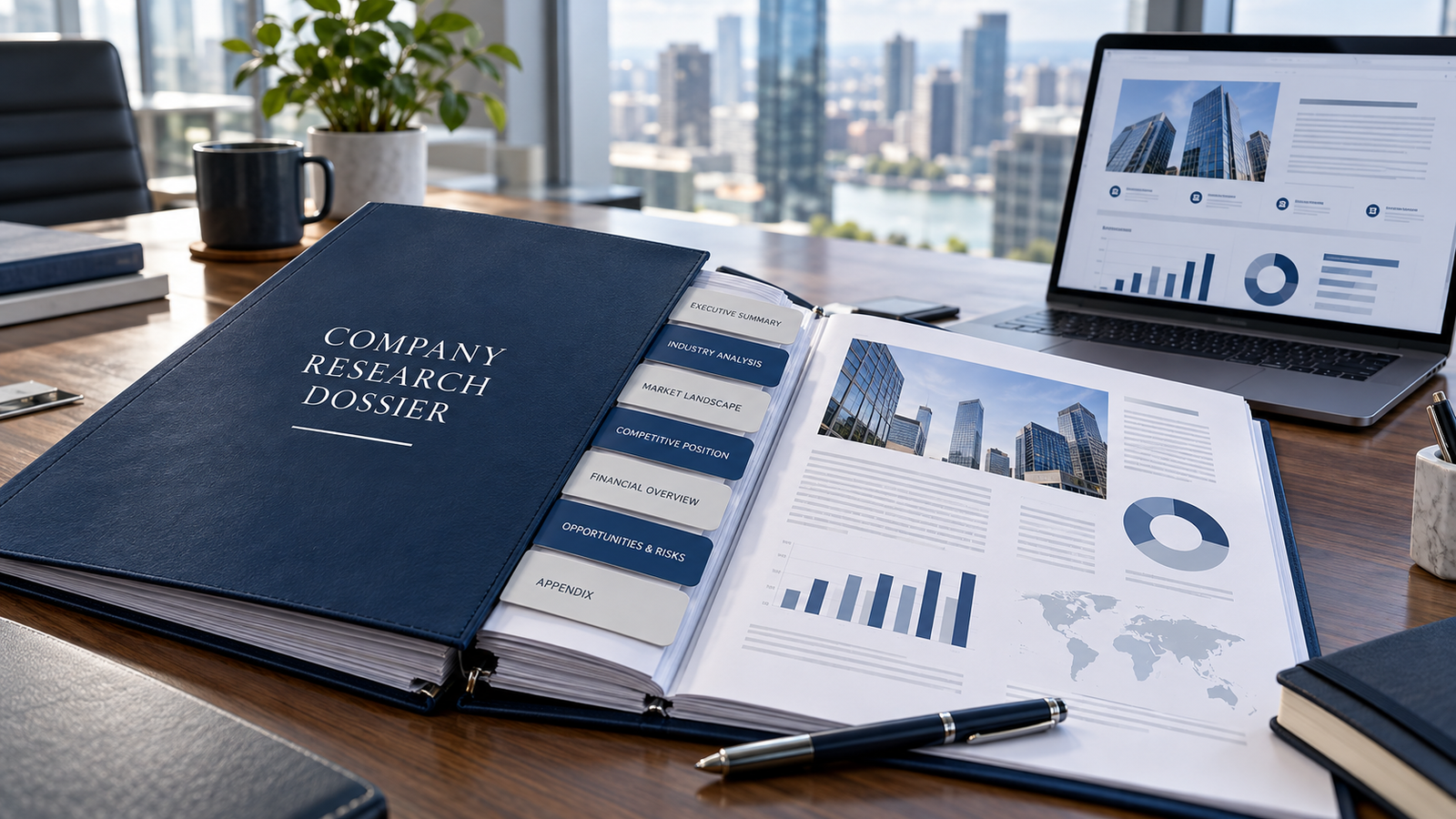

Researching a business can leave you with dozens of open tabs and no clear answer. A research dossier for target company analysis brings the useful information together so you can prepare for a meeting, assess a partnership or plan relevant outreach.
This guide explains what to include, where to find reliable evidence and how to turn your findings into a document that supports a specific decision.
What Is a Research Dossier for a Target Company?
A company research dossier is a structured document covering a business’s identity, activities, leadership, market position and relevant developments. It combines a company profile with evidence, analysis and unanswered questions.
The word “target” simply means the organisation you are researching. It could be a potential customer, employer, supplier, partner or acquisition prospect.
A useful dossier answers three questions:
- What do we know about this company?
- Why does that information matter to our objective?
- What should we investigate or do next?
The distinction matters. A list of facts describes a business; a dossier explains how those facts affect your next move.
Define Your Purpose Before You Start
Begin with one sentence describing the decision your research should support.
For example: “Assess whether this company is a suitable customer for our website translation service.”
That objective gives your research boundaries. You would investigate the company’s operating markets, website languages and public expansion announcements. Executive biographies might provide useful context, but they should not dominate the document.
Different purposes require different priorities:
| Research purpose | Main information to investigate |
|---|---|
| Sales prospecting | Customer needs, business priorities and relevant roles |
| Job interview preparation | Products, culture, recent developments and role expectations |
| Partnership assessment | Audience fit, capabilities and reputation |
| Supplier evaluation | Delivery capacity, financial information and service history |
Set a deadline and decide what evidence you need before making a recommendation. Otherwise, company research can expand without improving the decision.
What Should the Dossier Include?
Keep the document easy to scan. Put the most useful findings first and supporting detail afterwards.
Company Identity and Business Model
Record the legal name, trading name, official website, registration jurisdiction and core activities. Distinguish the business you are researching from its parent company or similarly named organisations.
Explain how it earns revenue in plain language. For example, does it sell subscriptions, manufacture products, charge transaction fees or provide professional services?
Leadership, Customers and Market Position
Identify relevant executives and business functions using public professional information. For outreach, knowing which team handles your subject is often more useful than collecting every director’s name.
Describe the customers the company serves and compare a few direct competitors. Use specific differences—such as product scope or service model—instead of unsupported labels like “market leader”.
Developments, Risks and Open Questions
Include announcements that could affect your objective, such as product launches, acquisitions or changes in leadership.
Keep unanswered questions visible. If a private company does not publish revenue, write “not publicly established” rather than estimating it from website traffic or staff numbers.
How to Build a Research Dossier for Target Company Analysis
Step 1: Confirm the Correct Organisation
Start with the official website and check the legal entity named in its footer, terms or company information pages.
For UK companies, Companies House provides information including registered addresses, incorporation dates, officers and filed documents. Match the company number wherever possible to avoid confusing similar names.
A registered address should be labelled accurately; do not automatically describe it as the company’s operating headquarters.
Step 2: Collect Primary Sources
Read the company’s product pages, annual reports, investor materials and original announcements.
For many US public companies, Form 10-K provides detailed information about business activities, risks and financial results. The SEC’s guide explains how to navigate these sections.
Record the reporting period as well as the publication date. An annual report published recently can still describe conditions from an earlier financial year.
Step 3: Add Independent Context
Use reputable reporting, customer reviews and industry publications to identify questions worth investigating.
Treat these sources according to what they can establish. A customer review documents one person’s reported experience; it does not prove that every customer faces the same problem.
Similarly, a company announcement confirms what the business has announced. It does not independently prove that a planned project will succeed.
Step 4: Maintain an Evidence Log
For every important finding, record:
- The claim or observation.
- Its source and publication date.
- The date you checked it.
- Whether it is documented, company-reported, estimated or inferred.
- Its relevance to your research objective.
Official records still need careful interpretation. Companies House states that it does not check the accuracy of information filed on its register.
When sources disagree, preserve the discrepancy and identify what would resolve it.
Step 5: Write the Summary Last
Once you understand the evidence, write a short opening summary covering the company, the most relevant findings and your proposed next step.
Avoid recommendations that exceed the research. “Arrange a discovery call to establish requirements” may be justified when “submit a full proposal” is premature.
A Practical Company Research Dossier Template
Use this structure as a starting point:
| Section | What to record |
|---|---|
| Research objective | The decision or meeting the dossier supports |
| Company overview | Legal identity, website, locations and activities |
| Business model | Products, customers and revenue model |
| Relevant people | Public roles connected to your objective |
| Recent developments | Dated announcements and their implications |
| Competitive context | Comparable businesses and specific differences |
| Risks and gaps | Concerns, conflicting evidence and missing information |
| Recommended action | Next step and questions to ask |
| Source log | References, dates and evidence labels |
Give the document an owner and a “last reviewed” date so readers can judge whether it needs updating.
Turning Findings Into Useful Questions
Consider researching a US public company before a supplier meeting. Its 10-K can provide a real starting point for reviewing disclosed business risks. Your task is then to identify which risks relate to the service you provide.
For an illustrative sales example, imagine a software company advertises several implementation roles. That is a verified hiring observation if the vacancies are current. It may suggest implementation activity, but it does not prove customer backlogs or operational problems.
A useful meeting question would be: “What implementation priorities are behind the current hiring?”
That approach connects evidence to a conversation without presenting an assumption as fact.
Common Mistakes to Avoid
The most damaging mistakes often involve interpretation:
- Combining information about different subsidiaries.
- Treating old announcements as current conditions.
- Repeating revenue estimates without attribution.
- Assuming hiring automatically means financial growth.
- Collecting personal information unrelated to the business purpose.
- Producing a lengthy document with no clear recommendation.
Aim for enough detail to support the decision. Put additional material in an appendix when it interrupts the main argument.
FAQs
What is the difference between a company profile and a research dossier?
A company profile summarises a business. A research dossier adds supporting evidence, analysis, uncertainties and actions connected to a specific objective.
How long should a company research dossier be?
There is no universal length. Routine meeting preparation may need a short brief, while a complex assessment requires more evidence and supporting documents.
Can I research a private company without financial statements?
Yes. Research its identity, products, leadership and public developments. Clearly state which financial information is unavailable.
Can AI help prepare a company dossier?
AI can organise notes and suggest questions. Check important claims against the original sources and verify that cited documents support the summary.
When should I update the dossier?
Review it before using it for a significant decision or meeting. Recheck details that can change, including leadership, product offerings and company status.
Conclusion
A useful research dossier for target company analysis connects reliable evidence to a clear purpose. Confirm the organisation, record your sources, separate observations from assumptions and finish with a practical next step.
Choose one company and one decision, then complete the template above. Start with the official website and relevant registry records, and use the remaining gaps to shape your questions.