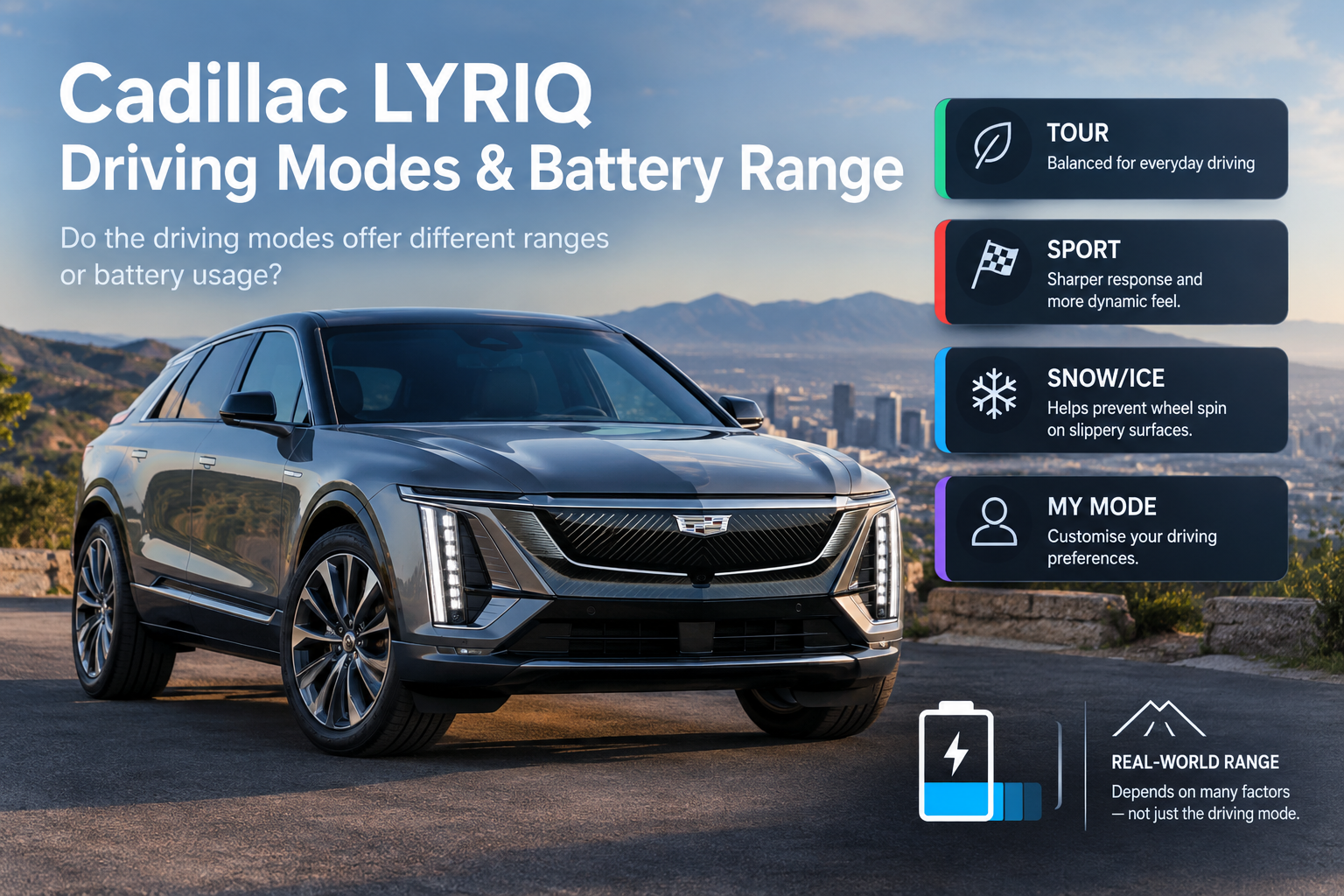

The Cadillac LYRIQ offers several driving modes, but there is an important detail: Cadillac does not publish a separate official range figure for Tour, Sport, Snow/Ice, or My Mode. The real difference is how each setting changes the vehicle’s response—and, indirectly, how much energy the driver may use.
What Cadillac officially says about LYRIQ drive modes
Cadillac confirms that the LYRIQ offers several selectable driving modes designed for different conditions and driving preferences. On the 2026 LYRIQ, those include Tour, Snow/Ice, Sport and My Mode. Tour is intended for everyday driving, while Sport provides a more immediate driving response. Snow/Ice is designed to help prevent wheel spin, and My Mode allows certain driving characteristics to be customized.
That distinction matters because none of these descriptions says that selecting a particular mode changes the physical capacity of the LYRIQ’s battery.
In other words, switching from Tour to Sport does not suddenly give the battery a different usable capacity. The battery remains the same. What changes is how the vehicle responds to accelerator input and other controls.
Does Sport Mode use more battery?
This is where the answer becomes less straightforward.
Cadillac describes Sport Mode as being calibrated for a stronger connection with the road, more immediate torque response and enhanced steering response. That setup can encourage harder acceleration, and harder acceleration generally requires more electrical energy.
But there is no official Cadillac statement saying that Sport Mode always consumes a specific percentage more battery than Tour Mode.
That means claims such as “Sport Mode reduces the LYRIQ’s range by exactly 10%” should be treated cautiously. No official source confirms a fixed percentage like that.
The driver’s behavior, speed, road conditions, temperature and other factors can have a much larger effect on the final range.
Tour Mode is the sensible everyday setting
Tour is the LYRIQ’s predominant everyday mode. Cadillac describes it as being tuned for a smooth ride and normal daily driving.
For someone trying to maximize practical range, Tour is therefore the logical baseline. It does not mean that Tour magically creates additional energy in the battery. Instead, it provides a balanced calibration that does not specifically prioritize sporty response.
Cadillac’s broader guidance also explains that acceleration rate, travel speed, tire pressure, weather and vehicle maintenance can all affect the LYRIQ’s range potential.
So a gentle driver in Sport Mode could potentially use less energy than an aggressive driver in Tour Mode.
What about Snow/Ice Mode?
Snow/Ice Mode is primarily about traction rather than maximizing range.
Cadillac says the setting is intended to help prevent wheel spin on snow or other slippery surfaces. That means the system modifies the vehicle’s response to make traction easier to manage.
It would be misleading to describe Snow/Ice as a dedicated “range mode.” Cadillac does not market it that way.
Its purpose is control and stability. Any effect on battery consumption depends on the circumstances in which it is being used.
My Mode makes the answer even more complicated
My Mode allows the driver to personalize characteristics such as accelerator responsiveness, steering feel and braking responsiveness.
That means two LYRIQs operating in My Mode could effectively be configured differently.
There is therefore no single My Mode range figure that can be applied to every vehicle or driver. The energy used will depend partly on the selected settings and, more importantly, on how the vehicle is driven.
Regenerative braking is a bigger part of the battery story
One feature that deserves attention when discussing LYRIQ efficiency is regenerative braking.
Cadillac says the LYRIQ has One-Pedal Driving settings and a steering-wheel-mounted Regen on Demand paddle. These systems allow the vehicle to recover energy during deceleration under appropriate conditions.
That is different from simply changing the drive mode.
Cadillac specifically notes that regenerative braking can capture braking energy and help add range. It also recommends charging to around 80% for everyday use because leaving room in the battery allows greater opportunity for regenerative braking.
So if the goal is understanding why one LYRIQ gets better real-world range than another, regenerative braking, driving habits and environmental conditions may be more useful areas to investigate than the mode name alone.
The battery does not have a different “size” in each mode
This is perhaps the simplest part of the mystery.
A LYRIQ’s battery capacity does not change when the driver selects Tour, Sport, Snow/Ice or My Mode. There is no separate battery reserve created by Tour Mode and no officially documented battery depletion penalty attached to Sport Mode.
What changes is the vehicle’s calibration and, potentially, the driver’s behavior.
Cadillac’s published range figures are tied to the vehicle configuration rather than a particular driving mode. For example, Cadillac currently lists different EPA-estimated ranges depending on LYRIQ propulsion configuration, including single-motor RWD and dual-motor AWD versions.
That is an important distinction: powertrain configuration can directly affect the published range, while selecting a drive mode does not come with a separate EPA range rating.
So which LYRIQ mode gives the best range?
There is no official Cadillac table ranking the LYRIQ’s driving modes by miles of range.
For normal driving, Tour is the most sensible starting point. Sport can use more energy in real-world driving if its sharper response leads to stronger acceleration, but there is no fixed official battery-consumption penalty. Snow/Ice should be selected when conditions require it rather than treated as an efficiency setting.
The most accurate conclusion is therefore surprisingly simple: LYRIQ driving modes influence how the vehicle behaves, but they do not give the battery different capacities or officially defined ranges.
Real-world range is ultimately shaped by the combination of driving style, speed, weather, tires, terrain, vehicle configuration, regenerative braking and other conditions. Cadillac itself confirms that these factors influence the LYRIQ’s range potential.
Author Bio
Daniel Mercer is an automotive and technology journalist covering electric vehicles, emerging vehicle technology and the practical questions that matter to everyday drivers. His work focuses on separating manufacturer specifications from assumptions about real-world EV performance